
How to Search Civil Dockets
Start with the county itself. The DeKalb County Courts and Dockets page posts General Sessions Civil and Circuit Civil PDFs. The files are organized by date. There is no public DeKalb trial-court database for searching by party name. Tennessee Public Case History covers appeals only. TnCIS does not list DeKalb among its public search counties. So the practical path is the posted date file first. Then comes the clerk for the official record.
Have a few details ready before you call or visit: the court name, the case number, the party names, and a rough filing or hearing date. General Sessions civil numbers follow the pattern 21GS1-YYYY-CV-NNN. Circuit cases look like 21CC1-YYYY-CV-NNN. Treat these as common shapes, not a guarantee that every case number matches them.
- Choose General Sessions Civil or Circuit Civil on the county docket index.
- Open the date-specific PDF and read its generated date and selected hearing range.
- Match the number, caption, subtype, judge, and hearing type.
- Check for a later or revised posting before travel.
- Call, visit, or arrange a written copy request with the correct clerk for the full file.
Two DeKalb Civil Docket Tracks
General Sessions Civil and Circuit Civil are two different tracks, not copies of one list. General Sessions takes limited civil matters, and its DeKalb settings include civil summonses, detainer warrants, and orders of protection. Circuit Court is the general-jurisdiction track and also hears certain appeals, with divorce, custody, and other broader civil labels appearing in its cases.
| Feature | General Sessions Civil | Circuit Civil |
|---|---|---|
| Observed number | 21GS1 with CV suffix | 21CC1 with CV suffix |
| Sample fields | Caption, filing date, subtype, parties, hearing, counsel | Caption, filing date, subtype, parties, hearing, counsel |
| Examples | Civil summons, detainer, protection order | Divorce, custody filing, Circuit civil claims |
| Record route | Circuit Court Clerk | Circuit Court Clerk |
Not every civil question belongs to those two courts. Chancery, probate, and equity matters run through Nicole Wright, Clerk and Master, not the Circuit Court Clerk. Name the right court first so your request lands in the office that actually holds the record.
What a Civil Docket Shows
A DeKalb County civil docket PDF is a calendar of scheduled work. In the General Sessions sample, each line carried the court and room, generated time, selected date range, case type, sort order, and judge. It also carried the case number and caption. The filing date, subtype, parties, hearing, attorneys, and whom each attorney represented rounded out the line. A Circuit sample showed similar fields. It could also list a later subtype or filing under the original case.
| Generated date | When the PDF was produced, not when the complaint was filed. |
|---|---|
| Case number | The strongest key for matching a posted line to a clerk file. |
| Caption and parties | The names listed when the calendar was generated. |
| Filing date and subtype | The displayed filing information; it is not the hearing or judgment date. |
| Hearing type | The purpose of a scheduled setting, not the judge’s result. |
| Attorney for | The listed counsel relationship, which may change after the PDF is made. |
Useful as it is, the docket is not the civil file. To see a complaint, service return, answer, exhibit, settlement, order, judgment, or enforcement paper, ask the clerk for it separately.
DeKalb Civil Docket Noon Posting
Timing matters here. The county posts the General Sessions civil docket by noon the day before court. That is the general rule. General Sessions civil settings usually land on Wednesday, though the current notice and file control. Expect a late-updating calendar, not an archive published weeks ahead.
What to do if no file appears: confirm the court and date, refresh the county index near its stated posting window, then call the correct office.
The General Sessions-facing office sits at One Public Square, Room 204, Smithville, TN 37166, phone 615-597-5175. The Circuit Court Clerk works from the same courthouse in Room 201, phone 615-597-5711, with weekday hours of 8:00 a.m. to 4:30 p.m. A quick call first saves a trip when the division or room is unclear.
Types of Civil Cases on the Docket
What shows up on a DeKalb civil docket depends on the court. The General Sessions sample and county materials point to smaller matters. These are expedited civil cases. The Circuit fee schedule and its sample cover a wider span. General-jurisdiction filings show up there. A label tells you the kind of entry, not the full allegations or the outcome.
- Civil summons matters, including the observed one-defendant subtype
- Detainer warrants and related possession proceedings
- Orders of protection, which require care with private safety information
- Contract, debt, tort, property damage, and personal-injury matters
- Divorce, custody, visitation, paternity, and other domestic filings
- Appeals from General Sessions or Juvenile matters where authorized
Chancery, probate, equity, and some domestic matters follow the Clerk and Master route instead. Do not assume every civil case hides inside the two posted PDF categories.
Check DeKalb Civil Docket Fees
Fees differ by court, so check before you pay. The county’s 2026 court fee schedule publishes separate General Sessions and Circuit civil sheets. These list categories, not locked-in prices. The county warns that fees can change without notice. Ask the clerk for the current total. Also ask about the service component, the copy type, and how you can pay.
The official General Sessions fee schedule lays out categories for summons, page-copy, certified-copy, lien, levy, post-judgment, show-cause, subpoena, wage-garnishment, and writ work.

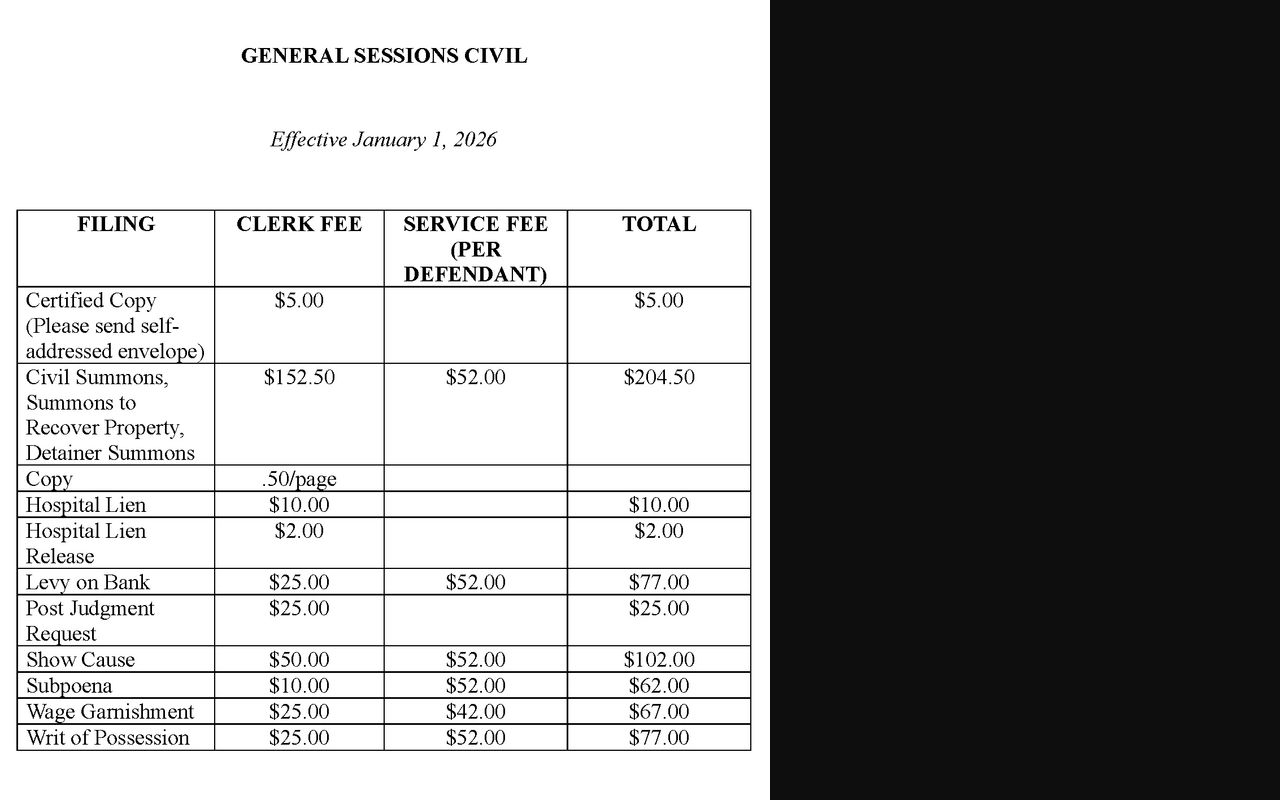
That schedule tells you which category to name; the clerk quotes the live amount for your request. The official Circuit civil cost schedule covers adoption, appeals, support work, contempt, contract and debt, divorce, name change, property, tort, subpoena, and other filing categories.

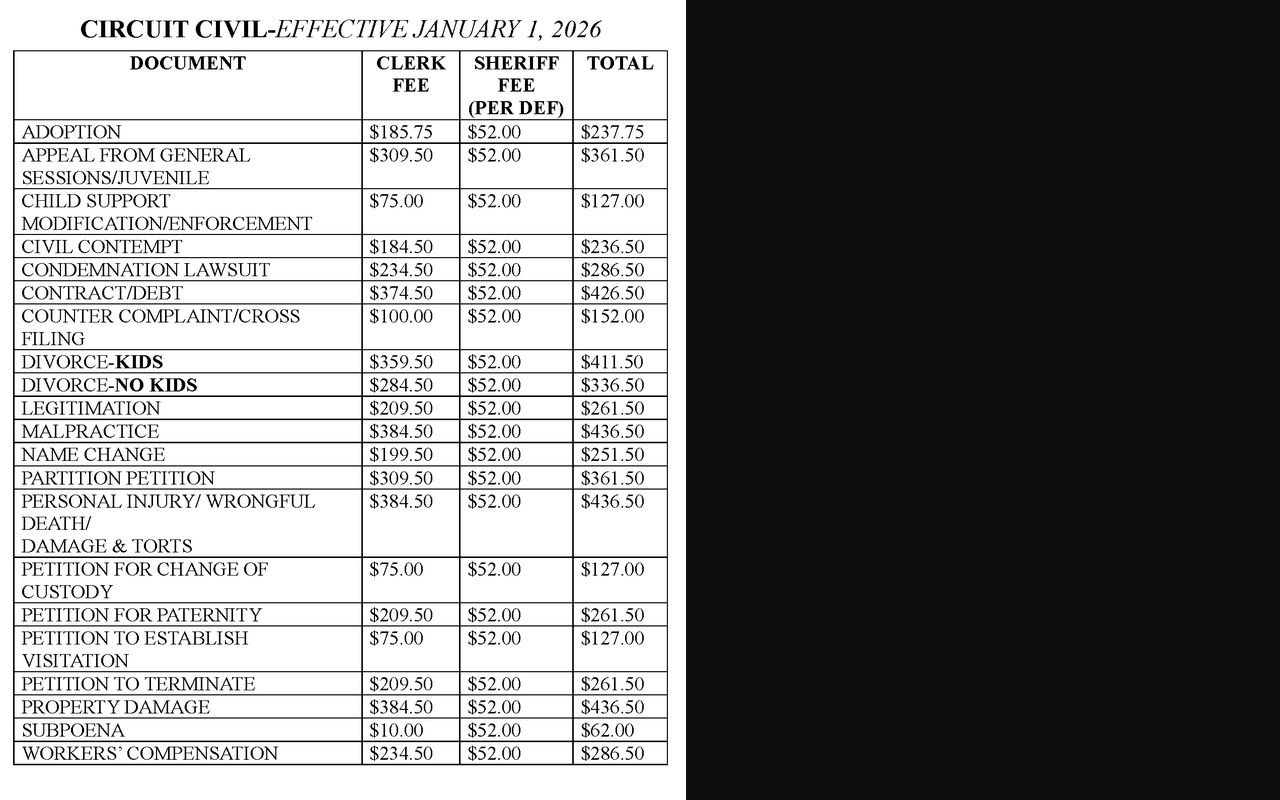
Put the two sheets side by side and the point is obvious. A requester must name the court and the filing type, because there is no single civil fee in DeKalb County.
Settings and Hearings on Civil Dockets
A filing date only marks the day something entered the record. A hearing date is different. It shows when the court will take up the matter. Neither date is the judgment date. The word “hearing” alone never tells you the result. It could be granted, denied, continued, or taken under advisement. The signed order that comes later settles the result question.
Under the Thirteenth Judicial District local rules, a trial setting can arise three ways. Counsel may agree on a date after consulting the court, file a motion, or pick one up at docket call. A continuance needs court leave and good cause. Party agreement by itself will not do it. Docket-setting dates can even be entered when counsel are absent. Lawyers must confirm the date themselves. The clerk and chambers both publish schedules for that purpose.
Read the PDF closely. It should show the court, room, judge, date, time, case number, and hearing label. For a wider date-check, the DeKalb County court calendar walks through the process. If a setting has changed, trust the clerk. Trust the latest court order over any older download.
DeKalb Civil Docket Versus File
The docket PDF answers one narrow question. A full civil file tells a deeper story. It can hold the complaint or petition, service return, response, exhibits, motions, settlement, orders, judgment, and post-judgment work. Local Rule 6 keeps papers and records in clerk custody, says copies are furnished at reasonable cost, and limits removal of files.
| Need | Ask for | Why |
|---|---|---|
| Next setting | Current docket PDF and clerk confirmation | Online files can change |
| Claim details | Complaint or petition | The caption does not state the full claim |
| Service status | Service return | The calendar may omit service proof |
| Outcome | Signed order or final judgment | A hearing label is not a ruling |
| Official copy | Certified named document | Certification comes from the custodian |
Spell out what you need. Give the number, court, record type, date range, desired format, and say whether certification is required. Ask how to send a mailed request and whether a self-addressed envelope is needed too.
Public Access to Civil Dockets
Tennessee court records are open by default. Tennessee Supreme Court Rule 34 guarantees public access unless another law, rule, or order applies. The Tennessee Public Records Act adds a wrinkle. It creates no central repository. Inspection and copy requests therefore go locally, to the office holding the file, and inspection alone generally needs no written request, though a records office may require one before making copies.
Privacy boundary: a public setting does not permit broad republication of protected identifiers or sensitive family and protection-order facts.
DeKalb local rules require redaction of Social Security numbers, account credentials, driver-license numbers, VINs, minors’ full names, and all but the year of birth.
Juvenile and sealed records require the clerk’s access instructions and may not appear in a public list.
Orders of protection and domestic cases involve children, addresses, and facts tied to safety. Ask only for the access you need. Check with the office holding the file. Ask whether any part is sealed, confidential, or redacted. And a gap on the docket proves nothing. A DeKalb County civil docket may simply not display a protected record that exists.
DeKalb Civil Docket Filing Context
FY 2024-25 Tennessee court statistics count 123 civil filings in DeKalb Circuit and 105 dispositions. Those numbers measure workload. They are not party counts. The gap between filings and dispositions does not prove backlog in any one case, and a filing and its disposition can land in different reporting periods.
Those figures cover Circuit civil cases only. They leave out General Sessions, Chancery, Juvenile, and municipal civil events in DeKalb County, so treat them as scale rather than evidence about a named case.