
Searching DeKalb County Cases by Name
DeKalb County offers no confirmed name-search portal for its trial courts online. What the public gets instead is the Courts and Dockets index, a set of date-specific PDFs grouped by court and category. So a name search really means picking a likely date and opening the newest file for that court.
- Identify General Sessions civil, traffic, criminal, preliminary, Circuit civil, or Circuit criminal.
- Open the newest date PDF and use the browser's find command for the surname, then full name.
- Confirm the case number, caption, court, date, and party role before treating a result as a match.
- Check add-on or revised files and then contact the responsible clerk if no reliable match appears.
People share names, and spellings drift. A "State of Tennessee vs." caption is not a finding of guilt, and a listed hearing is not a disposition. Remember that one PDF covers only its stated date range.
| Search Item | Type | Required | Use |
|---|---|---|---|
| Likely court/category | PDF selection | Yes | Chooses the local docket track. |
| Party name | PDF text | No | Narrows entries but does not prove identity. |
| Hearing date | Date range | No | Selects likely current and add-on files. |
| Case number | Exact text | No | Best locator for clerk confirmation. |
No DeKalb Name Portal Confirmed
A payment page is not a DeKalb County case search. County and municipal payment vendors will happily take money for a citation you already know about, but they run no public court-record database. Treat a payment button as neither proof that a case exists nor a neutral way to inspect its docket.
No result is not “no case.” A person may be absent from one date PDF because another date, category, court, add-on file, or access rule applies.
Call the DeKalb Circuit Court Clerk at 615-597-5711 for routing on General Sessions, Circuit, Criminal, and Juvenile records. The office sits at One Public Square, Room 201, Smithville, Tennessee 37166. For General Sessions-facing court questions, the county page lists 615-597-5175 and Room 204. Walking in works too. When the web listing fails, in-person inspection and a specific copy request remain solid channels.
Searching DeKalb by Case Number
A complete number beats a name every time. DeKalb County files use patterns such as 21GS1-YYYY-CR-NNN and 21CC1-YYYY-CV-NNN. Those are observed formats, not a guarantee across every court year or matter. Search the full string first. If nothing comes back, try the distinctive numeric sequence and suffix. Then verify with the clerk.
In these files, GS points to General Sessions. CC1 looks like a Circuit division or part marker. No formal local public key explains it, though. The suffixes CR, CV, and TR mark criminal, civil, and traffic records. Never let the prefix alone decide jurisdiction.
That number is your bridge from the public calendar to a request. It unlocks the docket sheet, complaint, warrant, order, judgment, or full case file. Add the caption, court, and date range when you can.
DeKalb Case Codes Need Context
A single DeKalb County search can cross procedural stages. A felony may first sit on a General Sessions preliminary calendar. It can then move to a Circuit Criminal docket. A General Sessions appeal can open a Circuit setting while the lower-court history still matters. City ordinance and municipal traffic citations may stay with Smithville or Alexandria.
| Clue | Likely route | Verification |
|---|---|---|
| 21GS1 | General Sessions | County PDF and Circuit Court Clerk |
| 21CC1 | Circuit or Criminal material | Caption, category, and clerk |
| CV | Civil track | General Sessions or Circuit civil |
| TR | Traffic track | County or municipal court |
Chancery, probate, and equity questions go through a separate Clerk and Master route: Room 302, 615-597-4360. The County Clerk is a different administrative office. Don't substitute it for the judicial clerk.
What a DeKalb County Case Search Returns
The local PDF is built around the calendar. It can pin down a setting and set up a clerk follow-up, but it is not the complete case file. Check its generated date, selected range, page count, and sort order before trusting any entry.
| Case Number | The main locator, often using observed 21GS1 or 21CC1 patterns. |
|---|---|
| Style / Parties | The caption; confirm the role and number to avoid a false match. |
| Case Type | The selected civil, criminal, or traffic category. |
| Filed Date | A filing date shown in some civil records, distinct from hearing date. |
| Hearing | The displayed setting type and date, not a result or judgment. |
| Judge / Room | The assignment printed for that calendar snapshot. |
Criminal files can also list statute, count, classification, violation or arrest date, bond, and comments. Those fields carry allegations or scheduling data. They prove no guilt and give no live custody status.
When DeKalb Search Finds Nothing
Resist the urge to conclude anything from an empty result. Work a structured fallback. Recheck the date and category. Scan every page. Hunt for updated, preliminary, cost, or add-on files. Then ask the clerk where the matter belongs, whether General Sessions, Circuit, Criminal, Juvenile, Chancery, or a municipal court.
- Give the complete or partial case number.
- State the caption or party name needed to locate it.
- Provide the filing or hearing date range.
- Name the exact record sought.
- Ask about inspection, copies, redaction, and any fee.
Mailing or writing in for a copy? Include contact information and state certified or uncertified, paper or electronic. Tennessee's public-record framework may allow inspection without a written request, though a custodian can require one for copies. The clerk's preferred method controls the practical route.
Statewide vs DeKalb County Case Search
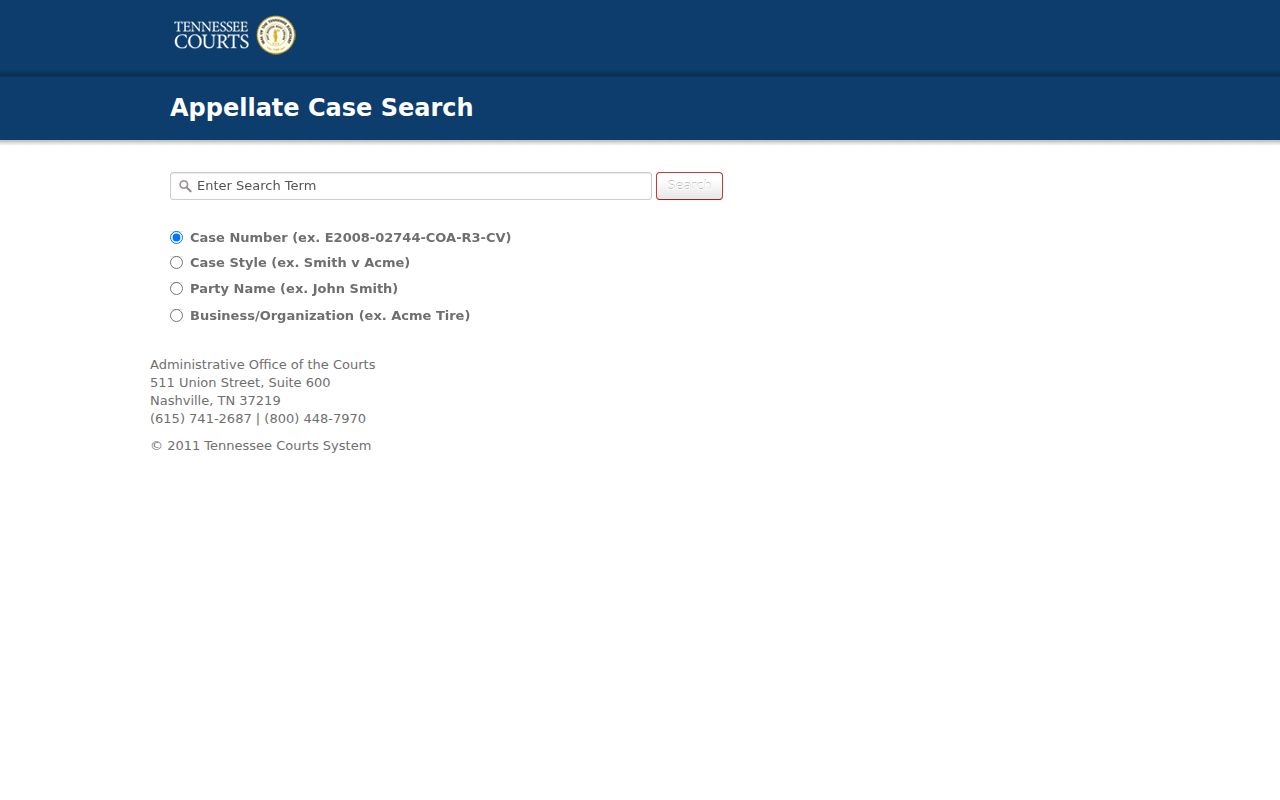
Tennessee Public Case History, known as C-Track, handles appellate matters. It spans the Tennessee Supreme Court, Court of Appeals, and Court of Criminal Appeals. It is not a universal DeKalb trial-court portal. Search modes cover case number, case style, party name, and business or organization. That range is broad. But trial-level work stays with the county.
| Tennessee appellate search | DeKalb County search |
|---|---|
| Appeals with records filed after September 1, 2006 | Current local date-and-category PDFs |
| Linked documents generally after August 26, 2013 | Calendar fields, not a full file |
| Best after a case reaches an appellate court | Best for a known local setting |
| Searches name, style, organization, or number | PDF find plus clerk confirmation |
The public TnCIS listings do not include DeKalb among participating public-web counties. That says nothing about the clerk's internal software. It just means a statewide-looking TnCIS tool should not be promised as local public access.
DeKalb Appeals Use C-Track
The official Public Case History source shows the appellate search layer. It applies to DeKalb County cases only once they reach a Tennessee appellate court.
C-Track's milestones and document history are no substitute for the DeKalb County trial-court file. Until an appeal begins, the record stays local. The relevant file remains with the court and clerk.
Federal Cases Need Another Search
Federal cases involving DeKalb County do not live in the county PDF system. They belong to PACER. DeKalb sits inside the Northeastern Division of the U.S. District Court for the Middle District of Tennessee. Confirm the court and division before pulling a docket. Federal and state case numbers follow different formats, and mixing them up wastes time.
PACER's official case finder needs an account for remote access and may charge fees. A terminal at the courthouse offers another way in. CourtListener's RECAP collection sometimes holds federal documents for free, though coverage is not guaranteed. Keep one limit in mind. None of these federal routes reach General Sessions or DeKalb Circuit records.
Access and Restricted DeKalb Cases
Public case search in DeKalb County does not open every file. The county seals juvenile records. Tennessee Supreme Court Rule 34 guarantees public access to court records. But it leaves room for exceptions set by law or court rule. So adoption, commitment, expunged, sealed, and some protective-order material may be missing or limited in a court docket.
Local rules also demand redaction of protected identifiers. That means a public file can carry withheld or masked material. A docket search that returns nothing does not prove a hidden case exists. Ask the clerk whether proof of status, statutory authority, or a court order is required. Ask for the rule behind any denial, too.
Access boundary: A public DeKalb County calendar entry is not permission to reproduce a minor's name, address, driver-license number, financial identifier, or other protected data.
Once you locate a case, check the DeKalb County court calendar for the current setting. Then confirm it with the clerk.